Role: UX/AI Designer
What I owned: Research synthesis, concept development, AI persona design, prototype (Figma + Ollama)
Focus: Behaviour change for exercise habits, AI coaching interaction, responsible data-driven design
Project type: AI-powered health app
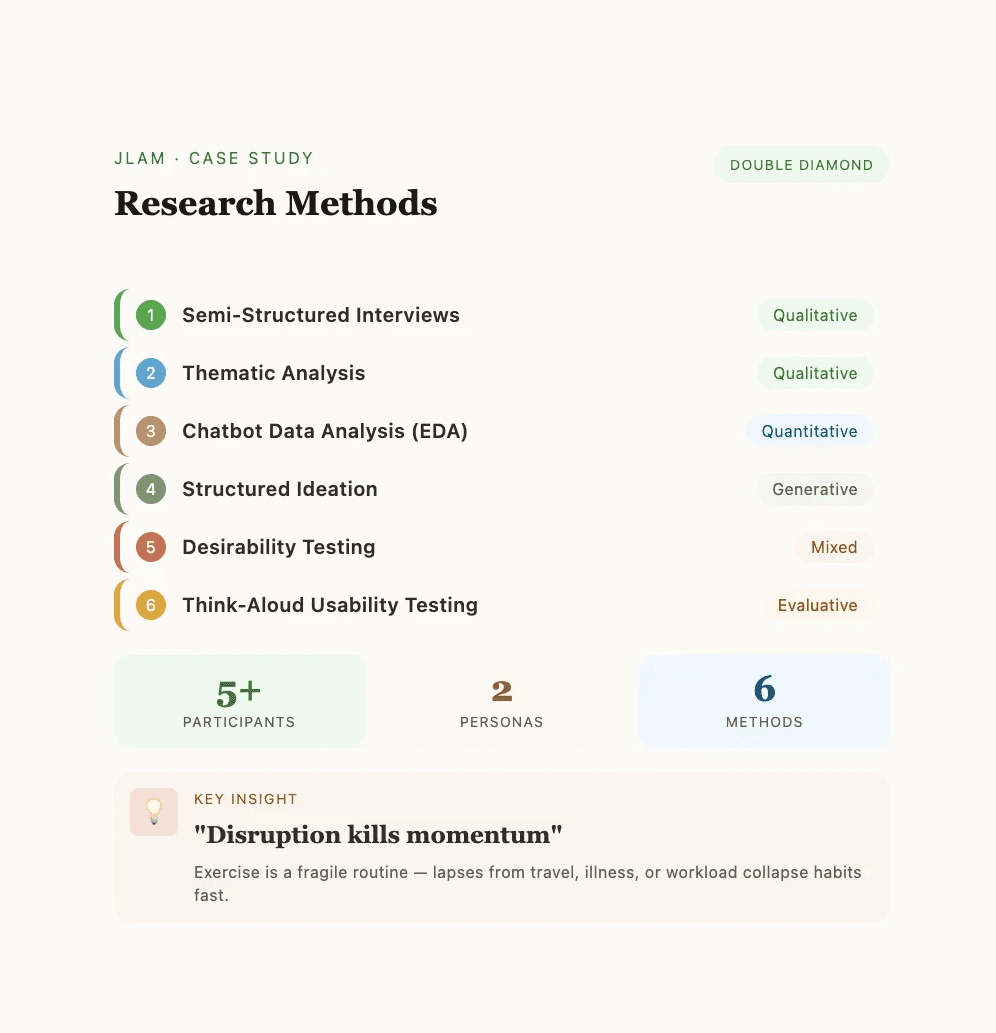
I started with desk research, user interviews, a qualitative survey of 47 participants, and an analysis of JLAM's existing Lampie chatbot logs. Three barriers kept surfacing: 78% of users cited time pressure as their main obstacle, 92% wanted to exercise but couldn't close the gap between intention and action, and over half reported guilt and emotional distress after missing sessions. A competitive analysis of five leading fitness apps confirmed the gap, none adapted to low-motivation states, and most reinforced all-or-nothing thinking through streak penalties and calorie tracking. The design opportunity wasn't another workout planner. It was a coaching system that meets users where they are emotionally and physically, without punishing them for bad days.
These findings shaped three design principles: the tool must work within 3–5 minutes for exhausted users, it must never use clinical or judgmental language, and it must give users full control over the AI's suggestions at every step. I grounded the concept in Self-Determination Theory and the Fogg Behaviour Model, then moved through over 30 divergent ideas, from a two-coach app, to a smart kettlebell, to a gamified projector, before converging on the final direction through MoSCoW prioritisation and expert feedback.


The final concept is AI Buddy, a software app with three AI coaching personas, each mapped to one research barrier. The Motivator addresses low intrinsic motivation through encouraging, sentiment-aware responses. The Planner tackles time scarcity with low-friction scheduling. The Energizer adapts session intensity when users report fatigue. A shared chatbot layer called Buddy routes users to the right coach based on an Energy Check-In completed at the start of each session, the AI recommends, but the user always decides. The key design move was Tired Mode: when a user reports low energy, the app adapts their habit to a gentler version, a 20-minute run becomes a 3-minute stretch, and protects their streak regardless. Two equal-weight options ensure the user is never punished for how they feel, and every AI suggestion includes a "Why this?" link that explains the reasoning chain, directly resolving the guilt and all-or-nothing thinking that research identified as the dominant barrier.
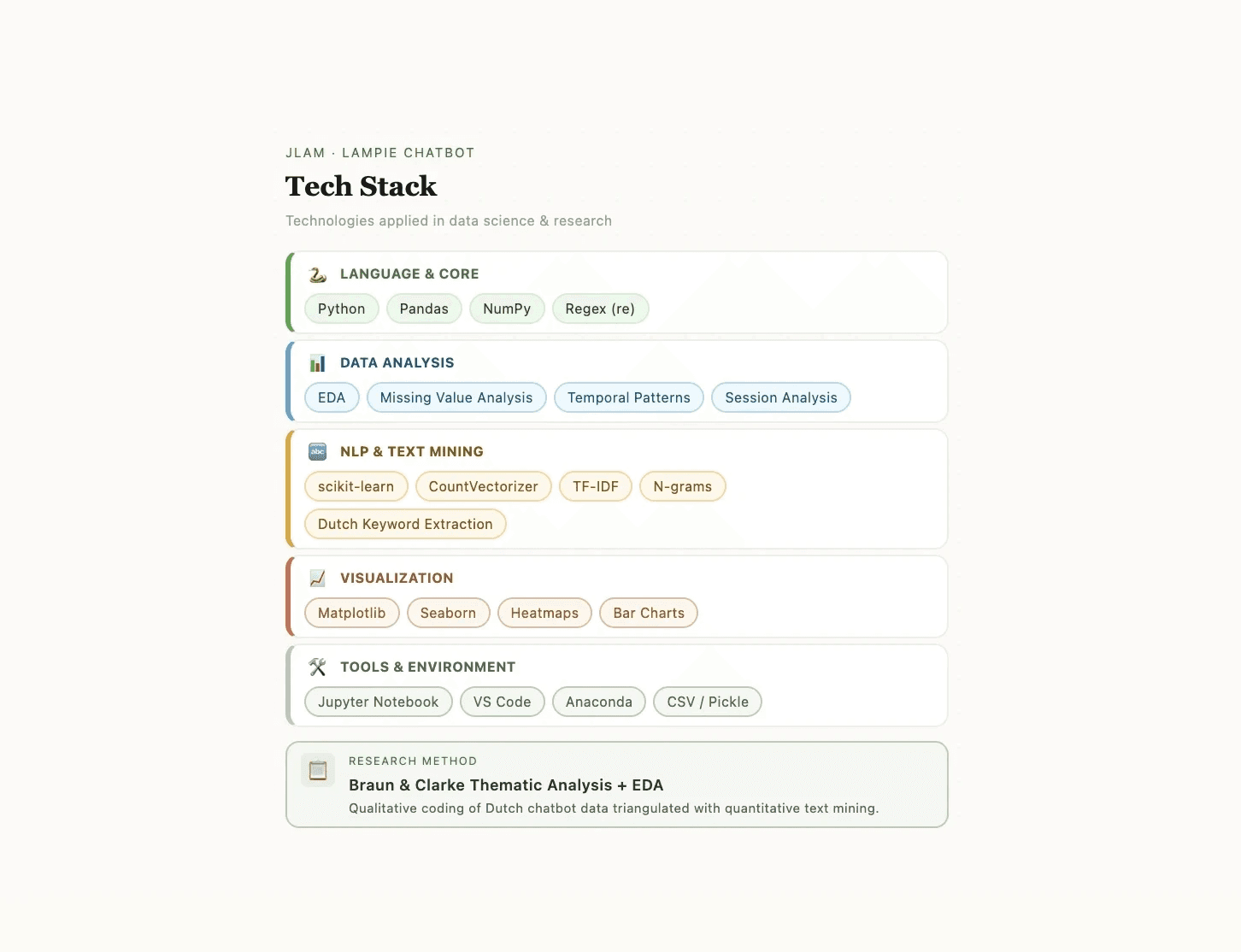
I prototyped the concept at two levels: a medium-fidelity Figma prototype with six key screens validated through expert walkthroughs, and a functional Python chatbot using Ollama (a local LLM runtime) that tested whether the three coach personas could maintain distinct tones through system prompts alone. The chatbot runs entirely on-device, no user data leaves the machine, operationalising privacy-by-design from the prototype stage.
These shifts translated into measurable improvements:
Of users wanted to exercise but couldn't bridge the motivation-action gap (research finding that shaped the entire concept)
Concepts generated and filtered through behavioural evidence before converging on the final direction
Research and ideation methods applied across divergent and convergent phases
Target time from app open to first coach interaction
